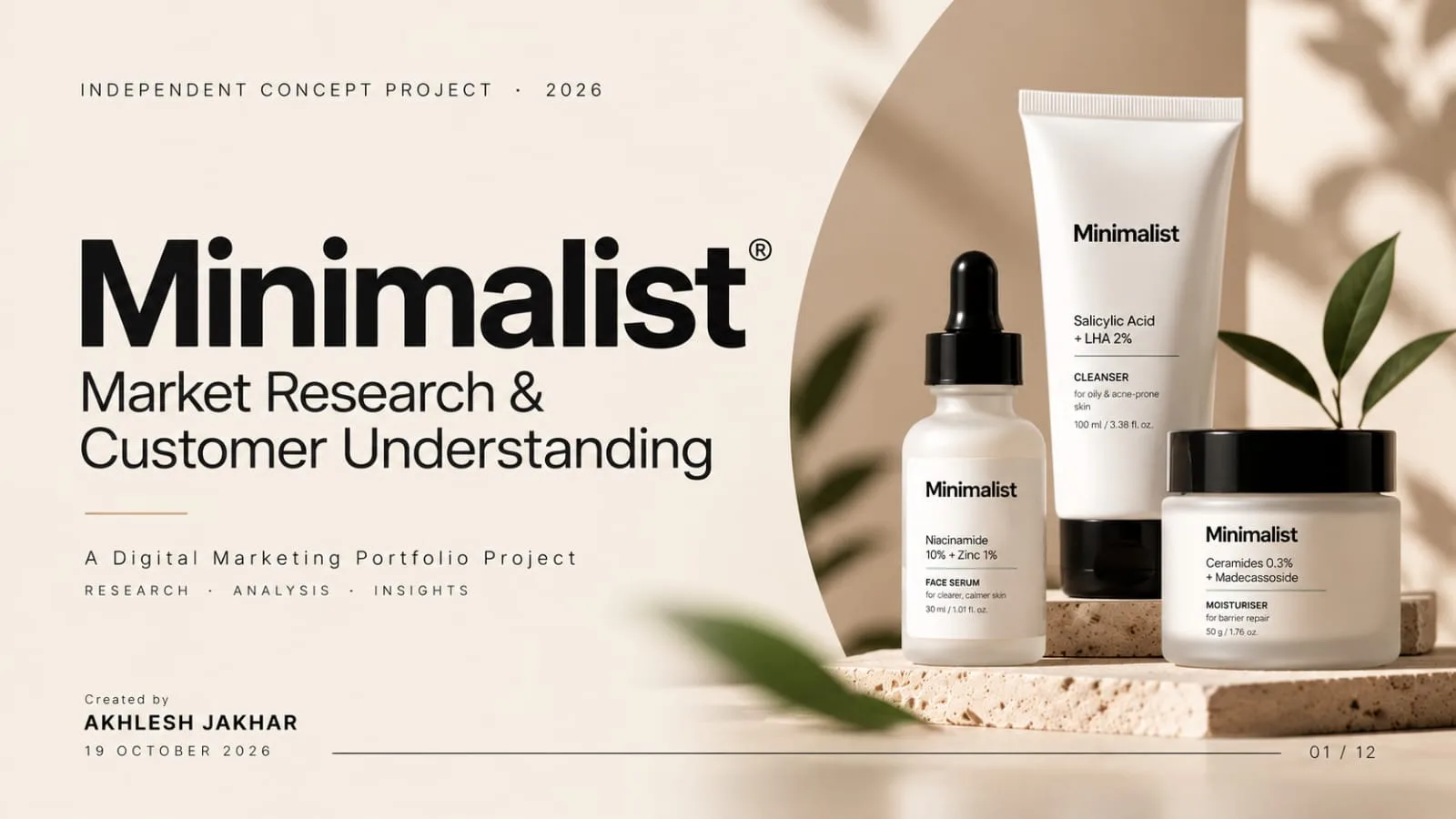
Minimalist: Market Research & Customer Understanding
How a science-led Indian skincare brand could earn more trust online. I researched the market, the audience, customer feedback and competitors, then turned it into a digital marketing strategy.
This is a self-initiated portfolio project. Minimalist did not commission, review or endorse it. Brand names and product imagery are used only for the purpose of analysis.
Project Overview
I chose Minimalist because it's a brand built on a clear idea: explain the ingredients and keep formulas simple. I wanted to see how well that idea reaches customers and where marketing could help it go further.
What I did
Desk research, review reading, competitor comparison, audience segmentation and strategy.
What I produced
A 12-slide deck covering market, brand, audience, feedback, competitors, opportunities, strategy, content and KPIs.
Who it's for
A portfolio piece showing my research and strategy process. Not a client deliverable.
Business Context and Problem
Minimalist is an Indian skincare brand known for a science-based approach, ingredient transparency and products for specific skin concerns. It sells cleansers, serums, moisturisers, sunscreens and more, mainly through its own website and online marketplaces.
The category is crowded. Indian brands such as The Derma Co and Dot & Key and global brands such as CeraVe and Cetaphil compete for the same customers, and skincare buyers compare a lot before purchasing.
The problem I set out to explore: how can a science-led, ingredient-transparent brand stand out and build trust with young online shoppers?
Research Objectives
- Understand the skincare market and the trends shaping it.
- Identify who Minimalist's potential customers might be.
- Examine how Minimalist positions itself against competitors.
- Explore customers' concerns, problems and preferences.
Research Methodology and Sources
Secondary research combined with my own qualitative reading of public customer comments.
| Source | Method | What I used it for |
|---|---|---|
| Fortune Business Insights: Skincare Market Size, Share & Industry Analysis | Desk research | Global market size and trends |
| Gaurav Agarwal's India skincare research page | Desk research | Indian market context and price positioning |
| Minimalist official website & product pages | Brand review | Product range, positioning and claims |
| Product reviews (Minimalist site, Amazon, Nykaa) | Qualitative theme coding | Customer likes, complaints and questions |
| Instagram comments | Qualitative reading | Informal customer sentiment |
| Competitor brand pages and listings | Comparison | Positioning, strengths and approximate price ranges |
Findings and Evidence
The category is large and growing Sourced
Source: Fortune Business Insights. These are global market figures. They do not represent Minimalist's revenue or the Indian market size.
The same report highlights four trends: interest in ingredients, personalised skincare needs, sun protection, and sustainable packaging.
What customers talk about My interpretation
The most frequent themes in reviews and comments were product effectiveness, skin suitability, delivery and availability, packaging, and price. Positive comments focused on visible results, gentle formulas and value for money. Negative comments mostly concerned delays, out-of-stock products, damaged packaging, or products that didn't suit a person's skin.
The deck reports a split of 68% positive, 20% neutral and 12% negative from my review reading. The number of reviews was not recorded, so read this as indicative only (see Limitations).
Where Minimalist sits among competitors My interpretation
| Factor | Minimalist | The Derma Co | CeraVe | Cetaphil | Dot & Key |
|---|---|---|---|---|---|
| Origin | India | India | Global (USA) | Global (Canada) | India |
| Positioning | Science-backed, transparent, simple | Dermatologist-led, affordable | Dermatologist-recommended | Gentle, sensitive skin | Trendy, natural ingredients |
| Price range (approx.) | ₹299–₹799 | ₹249–₹699 | ₹699–₹1,499 | ₹599–₹1,299 | ₹299–₹799 |
| Key strength | Ingredient transparency | Wide range, active marketing | Dermatologist trust | Trusted for sensitive skin | Strong social presence |
| Key weakness | Limited offline presence | Less focus on transparency | Higher price | Higher price | Seen as less clinical |
Price ranges are approximate, as noted during research in October 2026.
What this suggests My interpretation
- Customers appear satisfied with product quality; the frequent pain points are operational (delivery, stock, packaging).
- Expectations are high: people want visible results and want to know a product suits their skin before buying.
- Transparency is Minimalist's clearest point of difference, and education is the natural way to show it.
Audience and Customer Insights
Four potential segments, drawn from product information, reviews and industry research. Hypothetical These are research hypotheses, not Minimalist's official segments.
Young adults exploring skincare
Around 18–24, learning about skincare and looking for simple, effective products.
Acne and oily-skin concerns
Looking for solutions for acne, oiliness, blackheads and uneven texture.
Sun-protection seekers
Concerned about sun exposure and tanning, and want a sunscreen that feels comfortable.
Ingredient-conscious buyers
Research ingredients, compare products and prefer transparent communication.
Preliminary persona: the concern-focused young skincare buyer Hypothetical
Reads reviews, compares products and looks for real customer experiences. Wants clear information, comfortable textures, accessible pricing and trustworthy reviews. Motivated by healthier skin, visible results, understandable information and good value. Their questions before buying:
- Will this product suit my skin?
- Are the claims realistic?
- How should I use it?
- Will my order arrive on time?
Strategic Recommendations
Recommendation A content-led, multi-channel approach with four objectives: increase brand awareness, build customer trust, drive sales growth, and strengthen loyalty.
Customer experience
Clearer order tracking and post-purchase communication, since delivery and packaging come up often in complaints.
Skincare education
Simple, science-based content that helps people choose the right product and use it correctly.
Digital presence
Consistent social content, SEO-led blogs and well-chosen micro-influencers in the skincare niche.
Product & market expansion
Longer term: more concern-specific products and international markets.
Channel roles
| Channel | Proposed job |
|---|---|
| Educational Reels, ingredient explainers, influencer collaborations | |
| YouTube | Long-form, expert-led skin-concern guides |
| Search ads on high-intent keywords, educational blogs, comparison content | |
| Email & CRM | Skincare tips, reorder reminders, personalised recommendations |
| E-commerce platforms | Optimised listings, reviews, festive and seasonal campaigns |
| Community & UGC | Real customer stories and routines, shared with permission |
Content and campaign ideas
Five content pillars: ingredient education, product how-to, real customer experiences, expert guidance, and lifestyle routines. Suggested cadence: 3–4 Reels, 3 static posts or carousels and 1–2 UGC stories per week, plus a monthly live Q&A and two long-form blogs a month.
#RealSkinRealResults
Customer transformation stories, shared with consent and realistic expectations.
Ingredient Series
Short Reels on key ingredients such as niacinamide and salicylic acid.
Simple Skincare, Real People
A user-generated content campaign around simple routines.
Limitations and Assumptions
- All findings come from publicly available online sources. No customers were surveyed or interviewed.
- Review analysis was qualitative. The number of reviews read was not recorded, so the sentiment split is indicative, not statistically representative.
- Audience segments and the persona are hypotheses based on reviews and product information.
- Market figures are global and do not describe Minimalist's own performance or the Indian market.
- Competitor prices are approximate ranges and can change.
- The deck includes example KPI targets to show how targets would be set. They are illustrative and are not Minimalist's real figures.
What I Learned
- How to run market research and read real customer feedback with care.
- How to build a practical digital marketing strategy from research.
- Competitor analysis, content planning and performance measurement.
- More confidence using data and evidence to make recommendations.
- Recording method details (sample size, dates) matters as much as the findings.
Next Steps and How to Test the Strategy
Strengthen the research
- Re-run the review analysis with a recorded sample size and selection method.
- Validate the four segments with a short survey or a few customer interviews.
- Date-stamp every competitor price and source.
Test the strategy Hypothetical
Pilot the Ingredient Series for four weeks and track each stage of the customer journey:
Proposed tracking tools: Meta Business Suite, Google Analytics, Google Ads, an e-commerce dashboard, an email marketing tool and a social listening tool. For the customer-experience recommendation, the test would be whether the share of delivery and packaging complaints falls after tracking messages improve.
The Full Deck
All 12 slides. Click any slide to view it larger.